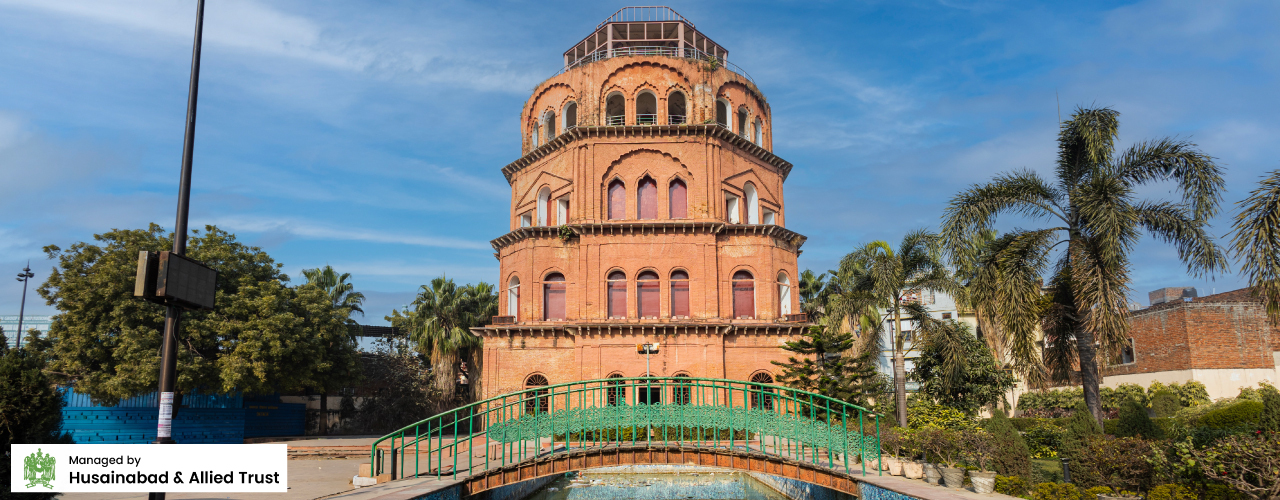
Among Lucknow’s many historic landmarks, Satkhanda stands apart not for what it achieved, but for what it aspired to become. Rising silently in the Husainabad area, this unfinished tower is a powerful reminder of royal ambition, scientific curiosity, and an interrupted vision.
Sathkhanda was commissioned by Muhammad Ali Shah, the third King of Awadh, who ascended the throne after the death of his nephew, King Nasiruddin Haider. Though his reign lasted barely five years (1837–1842), it was one of the most significant periods in the architectural and civic history of Lucknow.

A Short Reign, A Lasting Impact
Despite being physically infirm, Muhammad Ali Shah personally managed much of the administration of his kingdom. His reign was marked by political challenges, including the appointment of four wazirs within five years, yet he succeeded in maintaining stability and a steady flow of revenue.
With his position firmly established, the King turned his attention toward the beautification and modernisation of Lucknow, particularly the Husainabad area. His vision was not limited to palaces and monuments but extended to essential civic infrastructure.
He paid £3,000 to the British for the construction of the Lucknow–Kanpur road via the Charbagh bridge over the canal, a major step in improving connectivity. He also laid a wide pakka road from Dilkusha through Rumi Gate to Husainabad, along which he developed a grand architectural axis.
Along this route, he built the Chhota Imambara at Husainabad and added several exquisite buildings on either side. Combined with earlier structures raised by Nawab Asaf-ud-Daula and subsequent rulers, these works transformed Lucknow into one of the most picturesque cities of its time.

The Dream of an Eighth Wonder
Muhammad Ali Shah was deeply influenced by the growing reputation of Lucknow as a city often compared to Babylon for its splendour. This comparison inspired in him an extraordinary ambition, to construct a structure so tall and distinctive that it would be regarded as the eighth wonder of the world.
It was from this desire that the idea of Sathkhanda was born.
Originally conceived as a seven-storeyed tower, Sathkhanda was planned not merely as a symbol of grandeur, but also as a functional structure for lunar observation. The tower was intended to assist in the scientific observation of the moon, an essential requirement for determining the Islamic calendar and religious observances.

An Incomplete Monument
Fate, however, intervened. The untimely death of Muhammad Ali Shah in 1842 brought construction to an abrupt halt. With the patron gone, the ambitious project was never resumed.
As a result, Satkhanda stands today as a four-storeyed structure, incomplete yet imposing. Its unfinished form lends it a distinctive character—one that evokes both curiosity and contemplation.
Symbolism and Legacy
Unlike many monuments that celebrate completion and perfection, Satkhanda represents interruption and unrealised aspiration. It reflects a moment in Awadh’s history when architectural ambition, scientific inquiry, and urban planning converged.

BARA IMAMBARA is closed on Fridays from 10 AM to 3 PM, while all other monuments and tourist places in Lucknow are open from sunrise to sunset, i.e., from 6 AM to 6 PM.
BARA IMAMBARA is a dynamic structure whose beauty changes with the sunlight throughout the day, so technically you can visit at any time of the day.
However, most tourists prefer sunrise as the monument looks like a blooming flower when the morning light bathes it in a rosy hue. Also, visiting early in the morning allows you to avoid both the heat and the crowds during the summer months. For those who want to take some perfect shots and don't want to wait in long queues, getting up early can be very beneficial.
However, visiting at sunset is also a good option. The temperature cools down and the monument is bathed in a soft, silvery light. There are usually more visitors at sunset than at sunrise. Patience is required to get some good pictures.
Day visit pass can be purchased online through the official website or at the pass windows located at both gates. The best time to visit is from October to March.
No
No, Bhool Bhulaiya is a part of Bara Imambara.
Lucknow is full of tourism possibilities for tourists. It contains five World Heritage Sites: Bara Imambara (Bhul Bhulaiya/Baoli), Chota Imambara, Picture Gallery, and Satkhanda. Visitors can explore Ambedkar Memorial Park, the Residency, Saadat Ali Khan Mausoleum, Dilkusha Kothi, Janeshwar Mishra Park, Nawab Wajid Ali Shah Zoological Garden, and Gomti Riverfront Park.
Any kind of shooting is prohibited in the Imambara premises, it can be done on the road outside the Imambara only after permission from the Police/District Magistrate/Chairman Husainabad and Allied Trust Lucknow.
No, Bara Imambara is a religious place, hence cultural programs are prohibited in the Imambara.
Powered by

© 2026 Getepay. All rights reserved