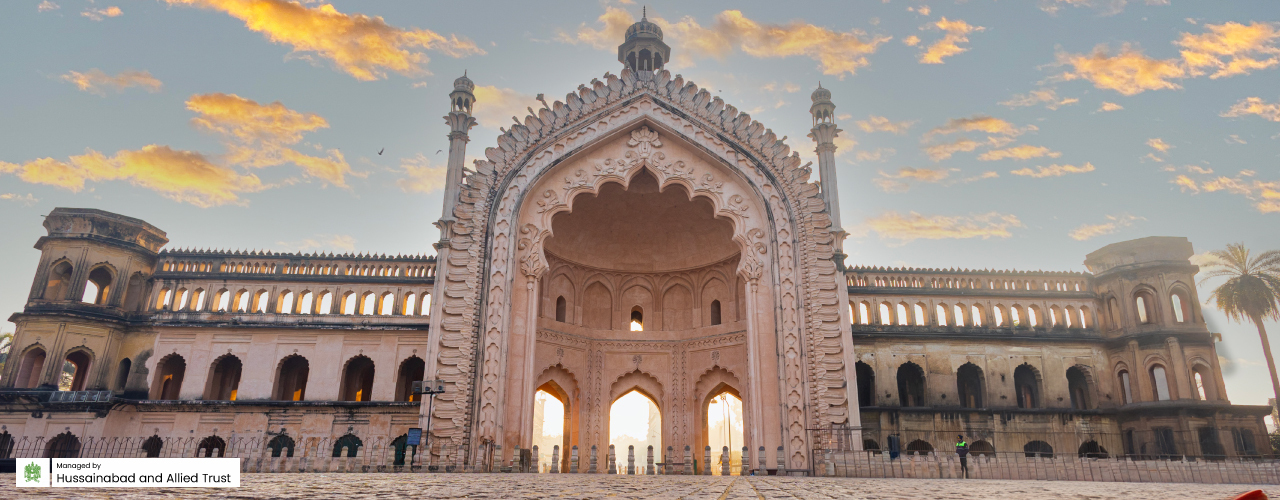
Just as Mumbai is instantly recalled through the Gateway of India, Lucknow finds its identity in the towering silhouette of Rumi Darwaza.
Rising to a height of 18.3 metres, this majestic gateway is a visual shorthand for the culture, refinement, and historical consciousness of Lucknow.
Architecture Born from Compassion
Rumi Darwaza owes its existence to an extraordinary moment in Awadh’s history. During the devastating famine of 1783–84, the fourth ruler of Awadh, Nawab Asaf-ud-Daula, initiated large-scale architectural projects not for grandeur alone, but as relief works to provide employment and dignity to famine-affected citizens.
Constructed over nearly two years and completed in 1786, the gateway reportedly cost an astonishing one crore rupees, a testament not only to its scale but also to the Nawab’s commitment to public welfare through architecture.

Who Designed the Gateway?
The authorship of Rumi Darwaza remains a subject of scholarly debate.
One school of thought attributes its design to an architect from Rum (Constantinople-city famous for the poet and philosopher Rumi), lending the monument its name. Others credit Kifayatullah, the chief architect of Nawab Asaf-ud-Daula.
Renowned historian Percy Brown suggested that the structure was inspired by the Sublime Porte of Istanbul.
However, the author of famous book- Lost Monuments of Lucknow, Syed Anwar Abbas offers a compelling and distinctive interpretation. He describes Rumi Darwaza as unparalleled, owing to its two-faced architectural form. The monument presents entirely different visual identities depending on the direction from which it is viewed.

A Gateway of Two Worlds
Viewed from the western side, Rumi Darwaza appears as a grand Mehrab. The rim of the arch is adorned with large lotus petals and intricate patterns, rising uninterrupted from base to crown.
On the eastern side, however, the monument transforms. The upper structure resembles the silhouette of a Rajput-style palace, culminating in a red sandstone chhatri that crowns the gateway. This crowning element, visible from all directions serves as Rumi Darwaza’s architectural signature.
An Influence That Shaped Lucknow
The grandeur of Rumi Darwaza did not remain confined to its own form. Its iconic Mehrab motif was repeatedly echoed in later constructions across the region.
Notable examples include:
• The main entrance of Jama Masjid, Lucknow
• The gateway of Husainabad Imambara, built by King Mohammed Ali Shah
• The facade of Nadwa at Badshah Bagh
• The gateway of Salar Masood Ghazi’s tomb at Bahraich, near Hardoi.
Through these replications, Rumi Darwaza quietly became a template for monumental architecture in Awadh.

More Than a Monument
Today, Rumi Darwaza is not just a historical structure, it is a civic emblem, a reminder that Lucknow’s greatness was built not only through royal ambition but also through social responsibility.
BARA IMAMBARA is closed on Fridays from 10 AM to 3 PM, while all other monuments and tourist places in Lucknow are open from sunrise to sunset, i.e., from 6 AM to 6 PM.
BARA IMAMBARA is a dynamic structure whose beauty changes with the sunlight throughout the day, so technically you can visit at any time of the day.
However, most tourists prefer sunrise as the monument looks like a blooming flower when the morning light bathes it in a rosy hue. Also, visiting early in the morning allows you to avoid both the heat and the crowds during the summer months. For those who want to take some perfect shots and don't want to wait in long queues, getting up early can be very beneficial.
However, visiting at sunset is also a good option. The temperature cools down and the monument is bathed in a soft, silvery light. There are usually more visitors at sunset than at sunrise. Patience is required to get some good pictures.
Day visit pass can be purchased online through the official website or at the pass windows located at both gates. The best time to visit is from October to March.
No
No, Bhool Bhulaiya is a part of Bara Imambara.
Lucknow is full of tourism possibilities for tourists. It contains five World Heritage Sites: Bara Imambara (Bhul Bhulaiya/Baoli), Chota Imambara, Picture Gallery, and Satkhanda. Visitors can explore Ambedkar Memorial Park, the Residency, Saadat Ali Khan Mausoleum, Dilkusha Kothi, Janeshwar Mishra Park, Nawab Wajid Ali Shah Zoological Garden, and Gomti Riverfront Park.
Any kind of shooting is prohibited in the Imambara premises, it can be done on the road outside the Imambara only after permission from the Police/District Magistrate/Chairman Husainabad and Allied Trust Lucknow.
No, Bara Imambara is a religious place, hence cultural programs are prohibited in the Imambara.
Powered by

© 2026 Getepay. All rights reserved