Originally, the site cradled Ghazi-ud-Din’s palace, where he resided as heir-apparent. Upon ascending to the throne, the prince, driven by a poignant sense of reciprocity, decreed the demolition of his palace to make way for his father’s eternal resting place.

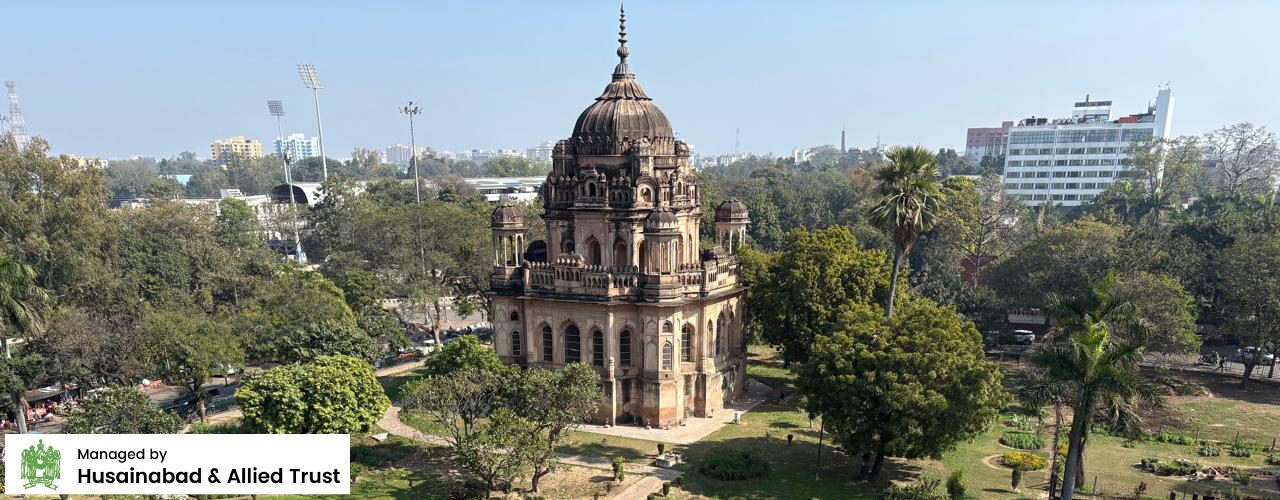
The Maqbara’s imposing structure culminates in a resplendent dome, while its floor showcases an exquisite black and white marble chessboard design. A designated pathway traverses the pavement, guiding the gaze to the subterranean vault beneath, where Saadat Ali Khan lies entombed.

The adjacent corridor conceals the final repose of three Begams, their resting places marked by unadorned recesses in the red brick floor. Their daughters’ tranquil slumber is preserved within the eastern gallery. A winding staircase descends into darkness, leading to a narrow passage where three recesses honor Saadat Ali Khan and his two brothers.

In the eastern corner, a smaller mausoleum cradles the sarcophagus of Musheerzadi, Saadat Ali Khan’s wife and Ghazi-ud-Din’s revered mother.
These hallowed grounds witnessed tumultuous times during the Mutiny. Cannons atop the tombs rained devastation, hindering General Havelock’s relief efforts.Adjacent to the principal Maqbara lies a humble, stone-flagged grave, sheltered by a low railing is called Sapper’s Tomb. Here, officers and men of the 23rd Company of Royal Engineers, fallen victim to abandoned gunpowder on March 17, 1858, find eternal rest. A delicate white marble tablet bears testament to this historical fact. All these 3 monuments are conserved by the Archaeological Survey of India

A Monument of Transition in Awadh’s History
Historical Background: The Last Mughal-Affiliated Nawab.
The mausoleum of Nawab Saadat Ali Khan represents an important chapter in Awadh’s political and cultural history. Saadat Ali Khan, the sixth Nawab Vazir of Awadh, was widely recognized as a capable administrator and a patron of architectural works. He holds historical significance as the last ruler of Awadh to formally acknowledge allegiance to the Mughal Emperor in Delhi — marking the closing phase of Mughal-era authority in the region.

Upon his death on 1 July 1814, his eldest surviving son, Gazi ud Din Haider, assumed leadership under considerable influence from the British Resident in Awadh and the Governor-General of the East India Company. Political and financial pressures compelled the new ruler to extend a substantial loan to the British to support their military campaigns, including operations in Rohilkhand and the Gorkha War in Nepal.

Political Transition and the Rise of the Kingdom of Awadh
In recognition of this support, British authorities encouraged Ghaziuddin Haider to assert sovereignty independent of the Mughal crown. On 19 October 1819, he was ceremonially crowned the first King of Awadh at Lal Baradari. This proclamation marked a turning point in Awadh’s political identity, symbolizing the region’s formal shift away from Mughal suzerainty and toward a new phase of regional kingship under colonial influence.

Construction and Historical Context of the Mausoleum
It was Gazi ud Din Haider who commissioned the grand mausoleum in honor of his father. Nawab Saadat Ali Khan was originally buried at his son’s residential premises. The residence was later cleared to construct the tomb at Khas Bazaar —an area that would subsequently evolve into the celebrated Kaisarbagh complex. Thus, the mausoleum stands not only as a memorial to a ruler but also as a symbol of dynastic continuity and architectural ambition.

Architectural Features and Design Elements
The mausoleum is distinguished by its refined composition and notable material detailing. The central hall features a checkered floor of black and white marble — an uncommon feature in this region, where marble was historically scarce. Rectangular verandas extend on all four sides of the structure, each punctuated by arched openings that allow natural light and ventilation while enhancing the monument’s symmetry.
The southern and eastern verandas house graves belonging to the wives and daughters of Nawab Saadat Ali Khan, reinforcing the mausoleum’s role as a familial resting place. Above the central chamber rises a large hemispherical dome, marked by narrow, regular fluting that adds visual rhythm. The dome is crowned by a prominent guldasta and a gilded finial, lending the monument a dignified vertical emphasis.

The Mausoleum of Khurshid Zadi
Situated diagonally across from the main structure is the mausoleum of Khurshid Zadi, the Nawab’s wife and mother of Ghaziuddin Haider. Known also as Murshid Zadi — reflecting her lineage as the daughter of a respected theologian — she held a revered position within the Awadh court. Her mausoleum complements the principal structure, forming a balanced funerary ensemble that reflects Awadh’s architectural sensibilities and familial traditions.

Cultural and Historical Significance
Today, the Maqbara of Nawab Saadat Ali Khan stands as a testament to Awadh’s architectural refinement and the political transitions of the early nineteenth century. Beyond its funerary function, the monument provides insight into a period when regional authority, colonial diplomacy, and cultural expression intersected to shape the historical trajectory of Lucknow.
BARA IMAMBARA is closed on Fridays from 10 AM to 3 PM, while all other monuments and tourist places in Lucknow are open from sunrise to sunset, i.e., from 6 AM to 6 PM.
BARA IMAMBARA is a dynamic structure whose beauty changes with the sunlight throughout the day, so technically you can visit at any time of the day.
However, most tourists prefer sunrise as the monument looks like a blooming flower when the morning light bathes it in a rosy hue. Also, visiting early in the morning allows you to avoid both the heat and the crowds during the summer months. For those who want to take some perfect shots and don't want to wait in long queues, getting up early can be very beneficial.
However, visiting at sunset is also a good option. The temperature cools down and the monument is bathed in a soft, silvery light. There are usually more visitors at sunset than at sunrise. Patience is required to get some good pictures.
Day visit pass can be purchased online through the official website or at the pass windows located at both gates. The best time to visit is from October to March.
No
No, Bhool Bhulaiya is a part of Bara Imambara.
Lucknow is full of tourism possibilities for tourists. It contains five World Heritage Sites: Bara Imambara (Bhul Bhulaiya/Baoli), Chota Imambara, Picture Gallery, and Satkhanda. Visitors can explore Ambedkar Memorial Park, the Residency, Saadat Ali Khan Mausoleum, Dilkusha Kothi, Janeshwar Mishra Park, Nawab Wajid Ali Shah Zoological Garden, and Gomti Riverfront Park.
Any kind of shooting is prohibited in the Imambara premises, it can be done on the road outside the Imambara only after permission from the Police/District Magistrate/Chairman Husainabad and Allied Trust Lucknow.
No, Bara Imambara is a religious place, hence cultural programs are prohibited in the Imambara.
Powered by

© 2026 Getepay. All rights reserved