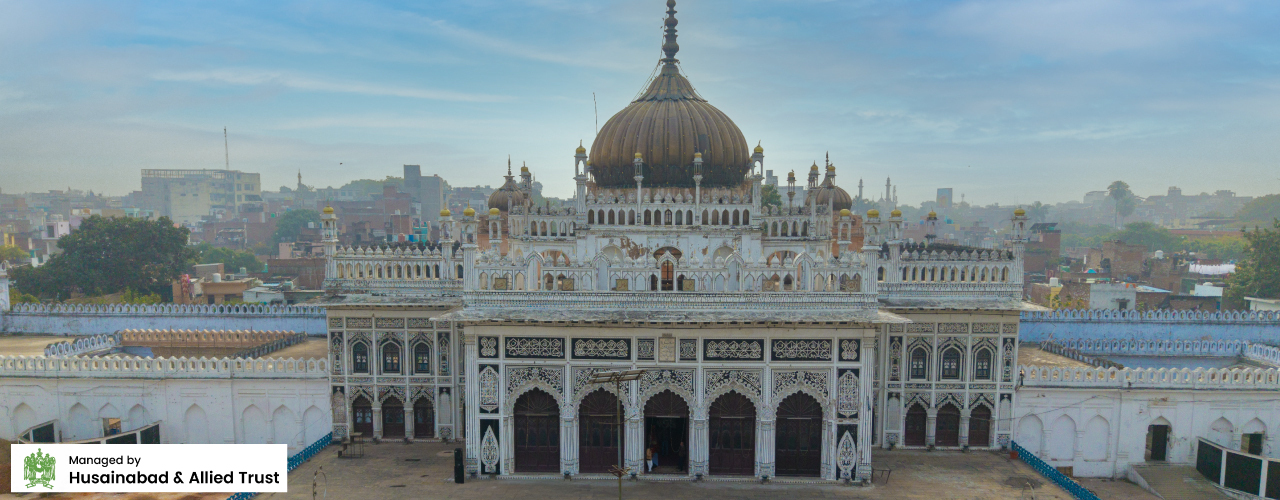
Among the many architectural landmarks that define Lucknow’s historic landscape, the Chhota Imambara, also known as the Imambara of Husainabad, occupies a special place for its elegance, symbolism, and visual splendour. Located in the old city, it is widely regarded as one of the most beautiful and aesthetically refined monuments of Lucknow.
The Chhota Imambara was built in 1839, in the second year of the reign of King Muhammad Ali Shah, the third King of Awadh.
A Monument of Faith and Fortune
Muhammad Ali Shah ascended the throne at the age of 63, an elevation he had never anticipated. Chosen and crowned by the British late in life, his accession was seen by him as an act of divine grace. The Chhota Imambara was thus conceived as a token of allegiance to his Shia faith and an expression of thanksgiving for what he considered a remarkable and unexpected turn of destiny.
The supervision of the project was entrusted to Azimullah Khan, the Superintendent of the King’s Ordnance and Building Department, under whose guidance the Imambara took its final form.
Visual Grandeur and Architectural Layout
The most striking feature of the Chhota Imambara is its glittering, gold-plated domes which are visible from a considerable distance. These domes lend the monument a distinctive skyline presence and immediately draw the attention of visitors approaching Husainabad.
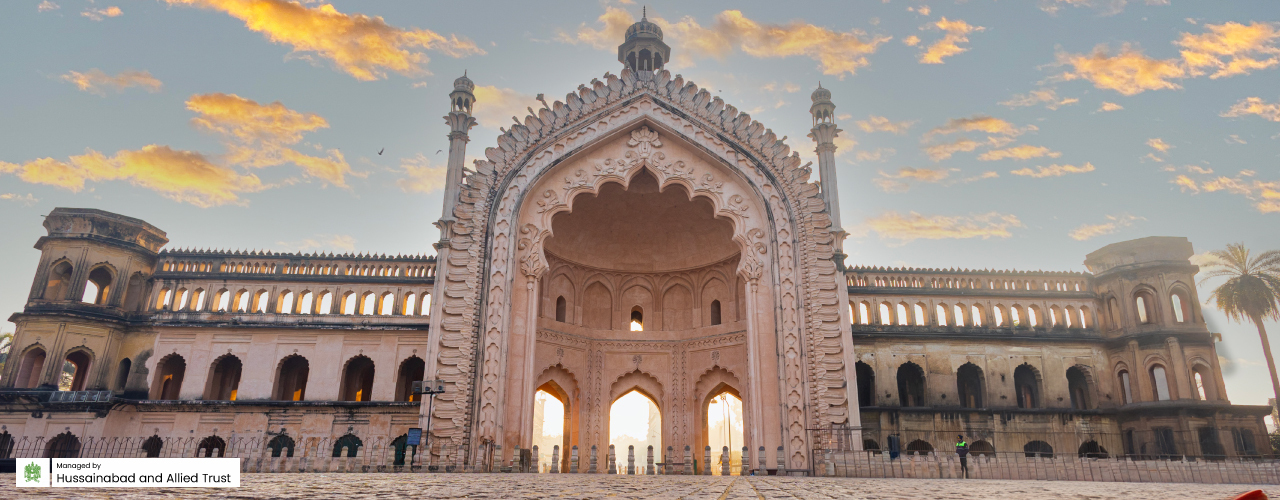
The Imambara complex is entered through two Tripolia gateways, placed on the eastern and western sides. Between them stands the main Phatak, a large ceremonial gate fitted with a heavy door that opens into the principal compound housing the Imambara’s main hall and associated apartments.
Directly opposite the main gate stands the Naubat Khana, where large drums were beaten to announce the naubat (the hours of the day).
Symbolism, Symmetry, and Detail
Upon passing through the main gate, visitors encounter two bronze-cast human figures, which form part of the monument’s lightning conductor system, a rare and intriguing functional detail in a heritage structure.
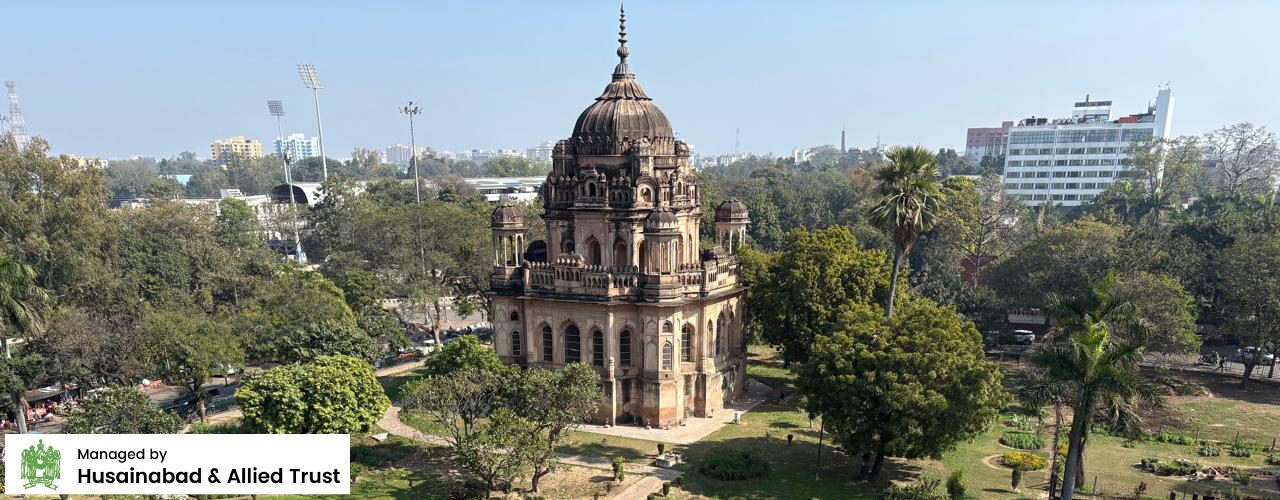
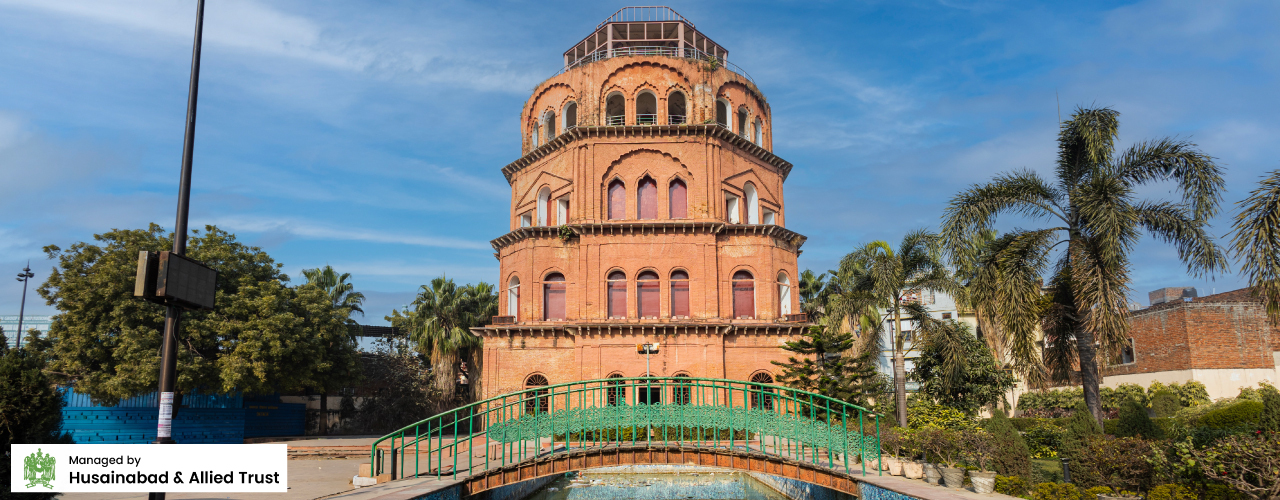
In front lies a small artificial lake, crossed by a bridge at its centre, adding to the serenity and symmetry of the complex. On either side of the hauz (small lake) stand two structures:
• One is a reduced-scale replica of the Taj Mahal, which serves as a mausoleum housing the graves of the King’s son, daughter, son-in-law, and one of the royal ladies.
• The other structure stands as its jawab, a matching architectural counterpart built purely for balance and symmetry.
 The Sacred Interior
Steps from the courtyard lead to the main hall, where majlis (assemblies) commemorating the martyrdom of Imam Hussain (A.S.) are held.
On the southern side of the hall is the Shahnashin, a raised platform where alams are mounted, symbolising the banners of Imam Hussain’s small army at Karbala. The hall also houses a large tazia made of wax, a rare devotional object, and a silver pulpit, from which the orator addresses the gathering during majlis.
Beneath the floor of the Azakhana hall, in the basement, lie the graves of King Muhammad Ali Shah and his mother.
Art, Calligraphy, and Refinement
Beyond its architectural beauty, the Chhota Imambara is also notable for its calligraphic ornamentation. The walls are adorned with framed specimens of decorative calligraphy in the Tughra style, combining artistic design with textual elegance. These calligraphic panels add an academic and aesthetic dimension to the monument, reflecting the intellectual and artistic culture of nineteenth-century Awadh.
A Living Legacy
The Chhota Imambara stands today not merely as a place of mourning, but as a monument of faith, gratitude, and refined craftsmanship. With its shimmering domes, balanced composition, sacred interiors, and artistic detailing, it represents the mature phase of Nawabi architecture in Lucknow.