When the fourth Nawab of Awadh, Nawab Asaf-ud-Daula, shifted the capital from Faizabad to Lucknow in 1775, he laid the foundation for the city’s transformation into a permanent political and cultural centre. His reign (1775–1797) marked the beginning of Lucknow’s architectural flowering.

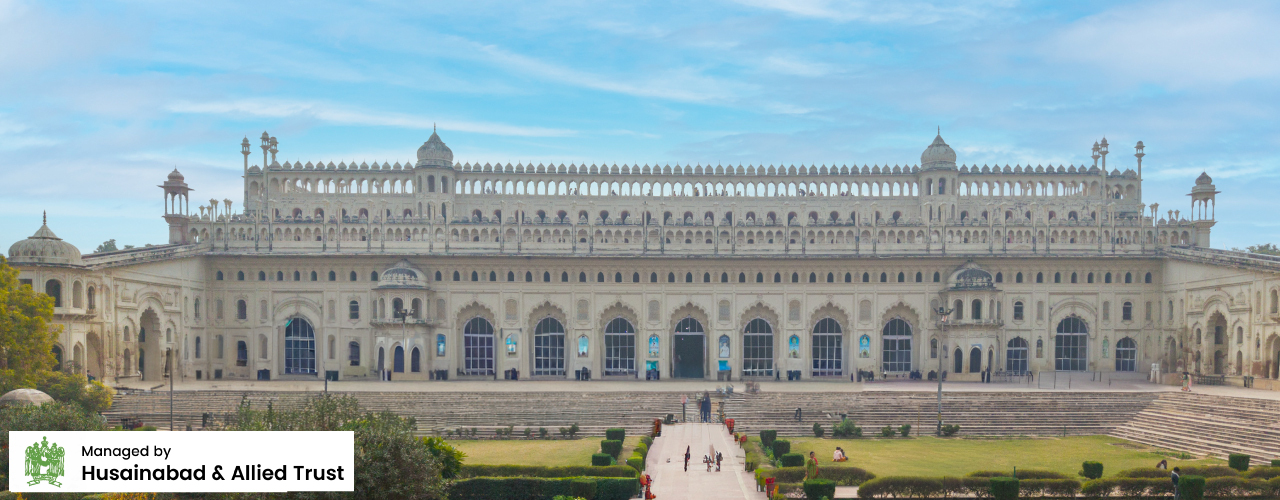
Among the earliest, largest, and most significant structures built under his patronage stands the Bara Imambara, originally known as Imambara Asafi, named in honour of its builder. Even today, it remains the largest building complex in the old city of Lucknow.

A Monument Born of Compassion
The Bara Imambara was conceived during one of the most difficult periods in Awadh’s history, the devastating famine of 1783–84. Rather than limiting his response to charity alone, Nawab Asaf-ud-Daula envisioned the Imambara as a large-scale relief project, providing employment and dignity to his famine-stricken subjects.

At its peak, the construction employed nearly 22,000 people at a time. In a deeply humane gesture, the Nawab made a remarkable provision: members of respectable families who felt embarrassed to work as labourers in daylight were allowed to work after sunset, when their identities would remain concealed.
The work carried out at night by unskilled labourers was often substandard and deliberately demolished during the day, only to be rebuilt by skilled artisans.

Planning, Scale, and Layout
Designed and planned by the renowned architect Qifayatullah of Delhi, the construction of the Bara Imambara complex took six years and reportedly cost nearly one crore rupees, a staggering sum for its time.
The complex comprises:
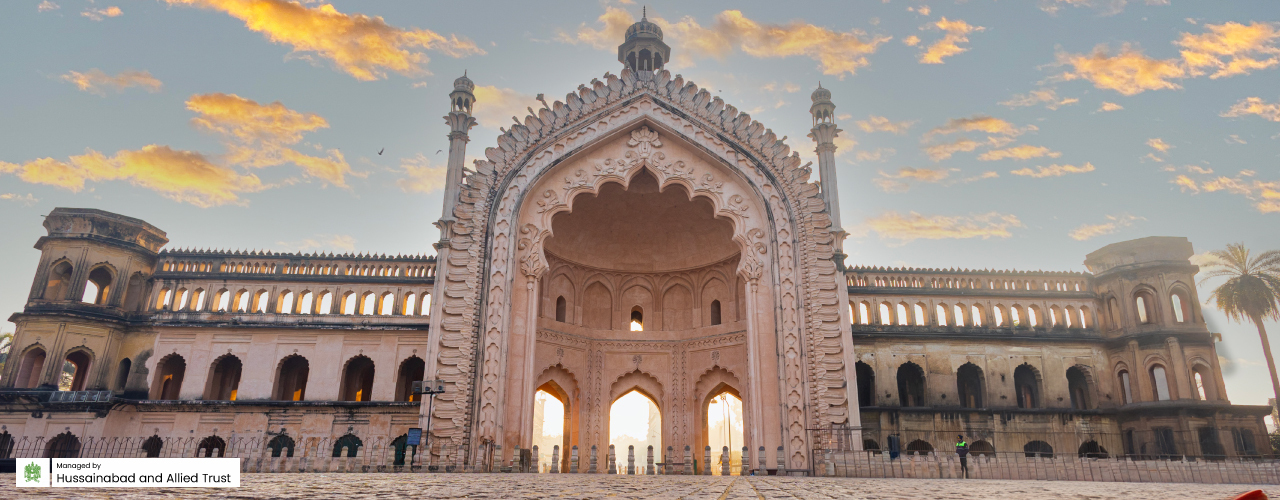
• Two stepped gardens with tall ceremonial gateways
• The Labyrinth
• A large mosque known as the Asafi Masjid
• A Bowli, constructed over a reservoir initially created to store water for construction activities. 
An Engineering Marvel
The main hall of the Bara Imambara is an architectural and engineering wonder. Measuring approximately 162 feet in length, with a ceiling rising nearly 50 feet above the ground, it features a massive vaulted roof.

The most remarkable aspect of this hall is that no beams, pillars, or intermediate supports are visible. The roof slab, estimated to be 16 feet thick and weighing nearly two lakh tons, appears to defy gravity.

A gallery runs along all four sides of the hall, and at one end is the Shahnasheen, a raised platform where zari and tazias , symbolic replicas of the tomb of Imam Hussain (A.S.) at Karbala are placed.

Flanking the hall are two large octagonal chambers, each nearly 53 feet in diameter:
• The eastern chamber features Rajput-style balconies and windows.
• The western chamber, known as the Kharbuza-wala Kamra, has a radially ribbed ceiling resembling the segments of a melon.
Local tradition links this chamber to the story of an elderly woman who sold melons for a living and whose land came in the way of the Imambara’s construction. Though no written record confirms the account, the continued placement of “Budhiya ka Tazia” within the Imambara lends cultural credibility to the legend.

Faith, Ritual, and Living Tradition
The Bara Imambara is fundamentally a religious and cultural space where Shia Muslims gather to commemorate the martyrdom of Imam Hussain (A.S.) during the month of Muharram.
The Mystery of Bhool Bhulaiya
One of the most intriguing features of the Bara Imambara is the Bhool Bhulaiya—a labyrinth of narrow passages, concealed staircases, and sudden directional changes. Only one correct path leads to the roof, while the others deliberately mislead the visitor, creating a unique blend of structural ingenuity and experiential mystery.

A Legacy of Benevolence
The popular Lucknowi saying—
“Jisko na de Maula, usko de Asaf-ud-Daula” perfectly captures the Nawab’s
reputation for generosity. The Bara Imambara stands as its enduring architectural expression.
Beyond its scale and splendour, the Bara Imambara remains a symbol of faith, empathy, engineering brilliance, and the humane vision of Awadh’s rulers.
BARA IMAMBARA is closed on Fridays from 10 AM to 3 PM, while all other monuments and tourist places in Lucknow are open from sunrise to sunset, i.e., from 6 AM to 6 PM.
BARA IMAMBARA is a dynamic structure whose beauty changes with the sunlight throughout the day, so technically you can visit at any time of the day.
However, most tourists prefer sunrise as the monument looks like a blooming flower when the morning light bathes it in a rosy hue. Also, visiting early in the morning allows you to avoid both the heat and the crowds during the summer months. For those who want to take some perfect shots and don't want to wait in long queues, getting up early can be very beneficial.
However, visiting at sunset is also a good option. The temperature cools down and the monument is bathed in a soft, silvery light. There are usually more visitors at sunset than at sunrise. Patience is required to get some good pictures.
Day visit pass can be purchased online through the official website or at the pass windows located at both gates. The best time to visit is from October to March.
No
No, Bhool Bhulaiya is a part of Bara Imambara.
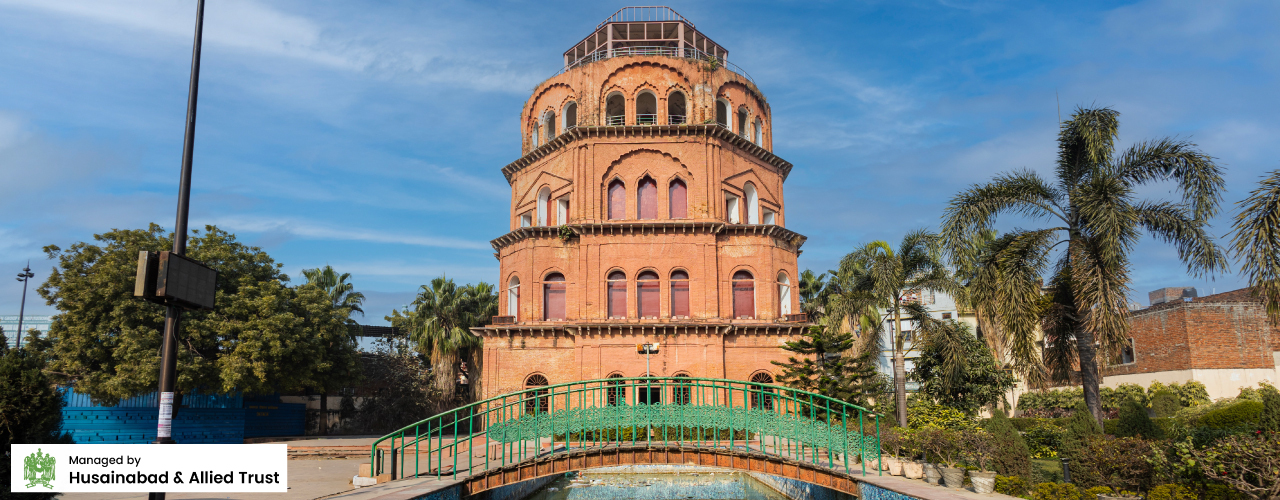
Lucknow is full of tourism possibilities for tourists. It contains five World Heritage Sites: Bara Imambara (Bhul Bhulaiya/Baoli), Chota Imambara, Picture Gallery, and Satkhanda. Visitors can explore Ambedkar Memorial Park, the Residency, Saadat Ali Khan Mausoleum, Dilkusha Kothi, Janeshwar Mishra Park, Nawab Wajid Ali Shah Zoological Garden, and Gomti Riverfront Park.
Any kind of shooting is prohibited in the Imambara premises, it can be done on the road outside the Imambara only after permission from the Police/District Magistrate/Chairman Husainabad and Allied Trust Lucknow.
No, Bara Imambara is a religious place, hence cultural programs are prohibited in the Imambara.
Powered by

© 2026 Getepay. All rights reserved